

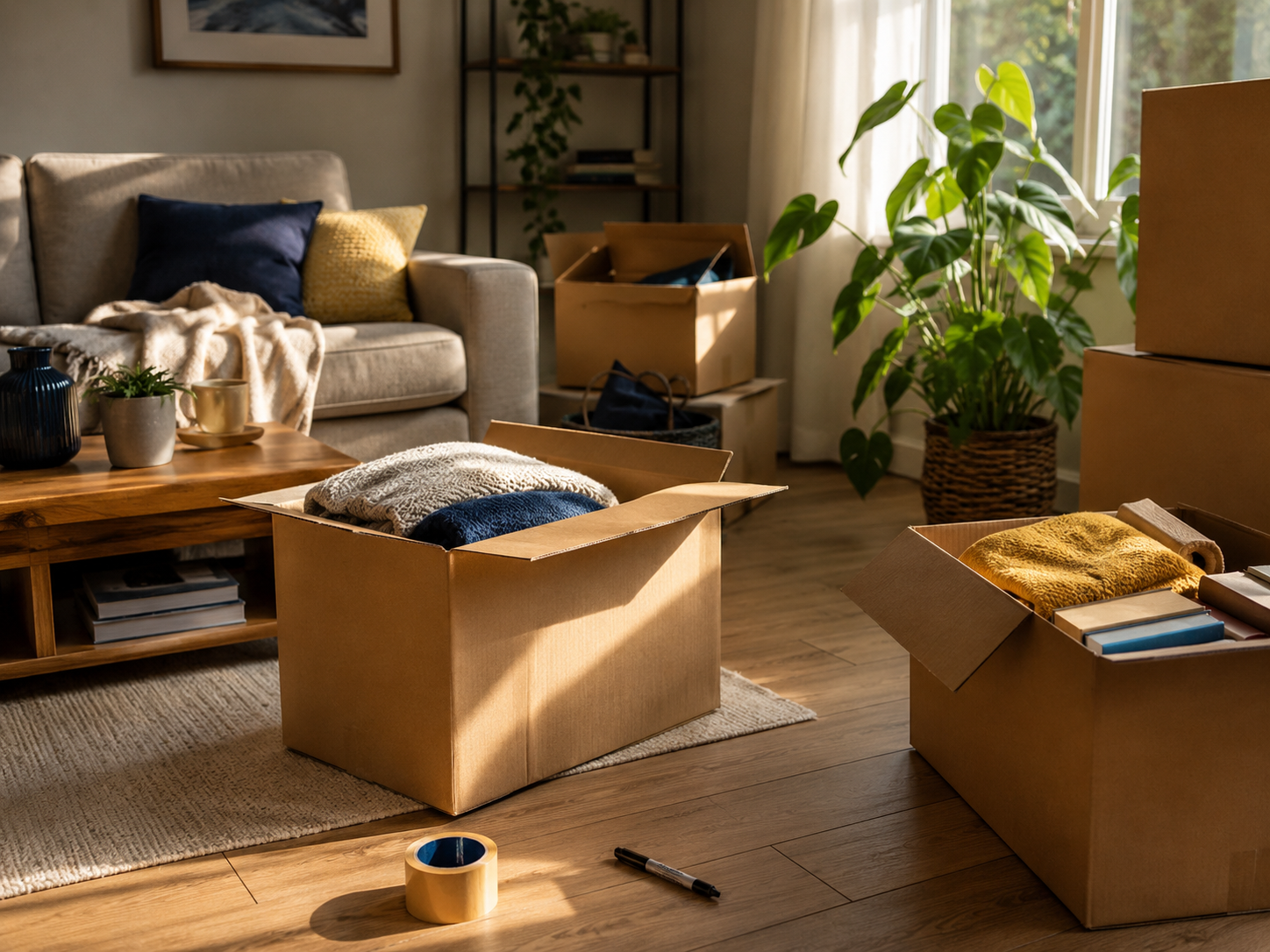
Packing an entire house sounds enormous. It isn’t, really — it’s just a lot of small jobs that people try to do all at once, usually on the last night.
Do it room by room, in the right order, and it becomes something you chip away at with the radio on. Here’s how.
Get your supplies first
Nothing slows a pack down like running out of tape at nine in the evening.
You’ll want: small boxes (for heavy things), large boxes (for light things), packing tape, bubble wrap or packing paper, a marker pen, and bin bags for the clear-out that always happens along the way.
A useful rule people get backwards: heavy items go in small boxes, light items in big ones. A large box of books is impossible to lift and usually splits. A large box of bedding is easy.
Start with the rooms you barely use
This is the trick that makes packing feel manageable. Begin where life isn’t happening.
The loft, garage and spare room first. These are full of things you won’t miss for weeks, and they’re usually the fullest spaces in the house.
Then work through in this rough order:
- Loft, garage, shed
- Spare rooms and studies
- Books, decorations, DVDs
- Out-of-season clothes
- Living room
- Bedrooms
- Kitchen
- Bathroom and daily essentials — last
By the time moving week arrives, you’re packing a kettle and a toothbrush rather than an entire home.
The kitchen: give it more time than you think
The kitchen is always the longest room. It’s full of fragile, awkward, oddly-shaped things.
- Plates travel on their edge, like records, not stacked flat — they’re far stronger that way
- Wrap glasses individually and fill the hollows with paper
- Pad every gap in the box, because things that can move will
- Keep one box of daily essentials — kettle, a few mugs, some cutlery — and pack it last
Label like you’ll be tired later
Because you will be.
Write on the side of each box, not just the top — you’ll be stacking them. Put the room it’s going to, not the room it came from, and add a couple of words about what’s inside.
“Kitchen — pans and baking” tells you everything. “Misc” tells you nothing, and you’ll open eleven boxes looking for the phone charger.
Mark fragile boxes clearly on more than one side.
The box you’ll be grateful for
Pack one first-night box and keep it with you rather than on the van:
Kettle, mugs, tea, phone chargers, toilet roll, hand soap, a towel each, medication, pyjamas, a change of clothes, and something to eat.
Everyone forgets this, and everyone regrets it at 10pm in a house full of sealed boxes.
Don’t pack these at all
Removal vans can’t carry hazardous items — paint, petrol, gas canisters, aerosols, fireworks and some cleaning chemicals. It’s a safety rule, not red tape. Use them up, or dispose of them properly before the move.
Keep documents, jewellery, keys and anything irreplaceable with you personally.
And if you’d rather not do any of it
That’s a perfectly reasonable choice. A professional packing team gets a house done in hours rather than weekends, brings all the materials, and packs to a standard that’s insured in transit.
For a lot of people the maths is simple: it costs less than they expected, and it buys back two entire weekends they’d rather spend on anything else.
FAQ
How long does it take to pack a house? Doing it yourself, most people need two to three weeks of evenings for a three-bedroom house. A professional team typically packs the same house in a day.
What should I pack first when moving? Start with rooms you rarely use — the loft, garage and spare room — then work towards daily essentials, leaving the kitchen and bathroom until last.
How many boxes do I need for a 3-bed house? Usually somewhere around 80 to 120 medium boxes alongside furniture, depending on how much you’re taking.